Blue-banded bees
I’ve only recently discovered the existence of these brightly-coloured native Australian bees.
I was visiting my parents a few weeks ago when I made an exciting entomological ‘discovery’ in the garden. Whilst looking at the plants, I saw a different and unfamiliar bee-like creature hovering near some flowers. It turned out to be a ‘blue-banded bee’ – I’d never seen one before!
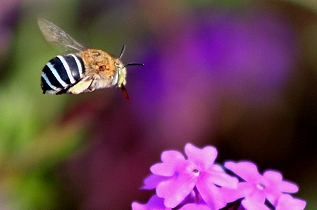
This blue-banded bee (Amegilla cingulata) is taking an interest in Verbena flowers.
The blue-banded bees caught my eye because of their iridescent colour and because they hovered. This is something English bees (Apis mellifera) cannot do. The blue-banded bees also moved between flowers much faster than English bees which made photographing and observing them very difficult!
Blue-banded bees (Amegilla cingulata) are native to Australia, but also occur naturally in Papua New Guinea, East Timor, Indonesia and Malaysia. Unlike other bee species, blue-banded bees are solitary insects. They typically build nests in sandstone, mud or the mortar-gaps in the brickwork of houses.

Detail of a blue-banded bee.
Blue-banded bees specialise in an unusual sort of flower pollination called ‘buzz pollination’. Normally flowers release pollen passively, but some species are specially designed to be pollinated by ‘buzz pollinators’ that grab onto the flowers and vibrate them quickly to release the pollen.
The tomato is a common example of a species that relies on ‘buzz pollination’. Without appropriate pollinators, commercial tomato yields are significantly reduced. In Australian glasshouse-based tomato farms, there is no common buzz pollinator available, so tomato growers are forced to use an “electric bee” vibrator to pollinate flowers. This is very labour intensive and adds cost to the final product.
So as a labour- and cost-saving remedy, tomato growers want the Commonwealth Government to allow the introduction of the European bumble bee (Bombus terrestris) as a glasshouse pollinator for their crops, despite the negative environmental consequences that would result. However the University of Adelaide has recently demonstrated that native blue-banded bees were just as effective glasshouse pollinators as bumble bees. Research is now focussed on the commercialisation of blue-banded bees for the tomato industry.
So in the future, there may be a big role for the humble blue-banded bee in industry. But in the interim, I hope to see more of these interesting insects buzz-pollinating the plants in the garden.
Comments are now closed for this article
Comments
81 responses to “Blue-banded bees”
how many specis of blue banded bees are their were not working for mum squed plz
plz we eed to know ths Adam
Hi I’m doing a school project and need to Know the answers urgently because it is due on thursday. Does the blue banded bee have 17 species, Does it live near caboolture river and is it dying because of pesticides?
Can you please replt to this before thursday
We need to Know!!!!!!!!!!!!!!!!!! 🙂
Adam can you please answer
My friends say hi coz they are working on the project with me
Hi S.R.P.S and Goku and everyone else doing Murder Under the Microscope.
The answers you seek are readily found in many articles you can source on the web. Why don’t you try doing some research and then reading what you find – that’s what Murder Under the Microscope is all about. It is sad that you expect someone to give you the answers.
I too have discovered this blog whilst doing research and have been quite excited in discovering this bee and other native bees. I have started looking in my garden too.
Kids, start researching !!!!! By the way, are you sure you have the right victim?
MUM
get a clue people give some good answers!!!!
I was looking for answers for murder under the microscope and I found NONE!
Not on.
I was looking for the threats towards blue banded bees and all you babbled on about was about your trip to your parents and You You and….YOU!!!!!
To S.R.P.S,
I know that you are working on MUM coz the accusation day is thursday and those items are on the list.
Iwill tell you that the Victim is the long-tailed macaque.
GOOD LUCK!!
Zahara
Hi can i speak to Zahara.
Kidding if this is Zahara you are on murder under microscope.Ok you mite know that.But can you pleas call me on 62597723 as soon as posilble. And i don’t suddy muder under the microscope.where do blue banded bees live.
Amen i mean thanks
busted tj hey ben i am in tjs class and we are doing mum.
I was looking for answers here too but i will have to go to another site. great pics adam. by the way is the blue banded bee threatened by the varroa mite . kidding. again busted tj.
Hi I’m doing MuM too!! Go do some research, OK???
Remember its the long tailed-macaque, and the tweed river and the sewage.
The real zahara
MuM office
I’m doing mum too!!!
no its not that victim dont listen to her its fake find the victim your own way!
Taylah
This was helpful because you have help us solve 1-3 things in Murder under the microscope 2009… Thank you
What are the threats to the blue-banded bee?
I am really interested in this amazing creature!!!!!!!!!!!!!!!!!!!!
hey
do you know how many species of blue-banded bees there are?
it would be much appriciated if you could tell me
thank you
anna
btw
stop flipping ppl off with your fake accusations
some ppl arent stupid
(can u tell me about the amount of species plz)
thx again
anna
no, blue-banded bees are the victims, unatural cold weather and genetically modified crops(illegal) is the villan!
How do Blue banded bees die?
does the blue bandid bee’s scales change colour beacause of the weather
We are building the Clay nests in Melbourne to attrct the Blue Banded Bee to our area.
What plants apart from Rosemary and Lavender attracts them to our garden?
Help.
IE:Assuming that they do live in our area.
PeterEm
Blue banded bees die because of habitat clearing and pesticides. in winter all the adult Blue Banded Bees die after they hav layed there eggs. the hatchlings hatch in the following Spring.
I hope i have helped solve some of your problems
That was a very informative blog adam
also very helpful in murder under the microscope
Blue Banded Bees major killer is habitat clearing, and i have been closly investigating the causes and effects of predators on blue banded bees.
Thanks for a very informative article adam
OMG! you actually could take photos of them? I’ve been up all day waiting for them, and when they came out, i was running everywhere trying to take photos, so good on you!
Blue Banded Bees r cool, what would we do without them?
u r sooooo lucky
did you know,the bee you are studying
dies in winter?!?!
it is annoyed by the varroa mite
and loves purple plants!!!