Blue-banded bees
I’ve only recently discovered the existence of these brightly-coloured native Australian bees.
I was visiting my parents a few weeks ago when I made an exciting entomological ‘discovery’ in the garden. Whilst looking at the plants, I saw a different and unfamiliar bee-like creature hovering near some flowers. It turned out to be a ‘blue-banded bee’ – I’d never seen one before!
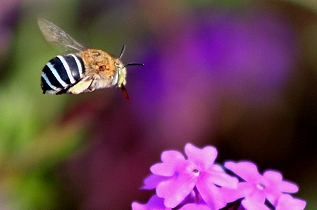
This blue-banded bee (Amegilla cingulata) is taking an interest in Verbena flowers.
The blue-banded bees caught my eye because of their iridescent colour and because they hovered. This is something English bees (Apis mellifera) cannot do. The blue-banded bees also moved between flowers much faster than English bees which made photographing and observing them very difficult!
Blue-banded bees (Amegilla cingulata) are native to Australia, but also occur naturally in Papua New Guinea, East Timor, Indonesia and Malaysia. Unlike other bee species, blue-banded bees are solitary insects. They typically build nests in sandstone, mud or the mortar-gaps in the brickwork of houses.

Detail of a blue-banded bee.
Blue-banded bees specialise in an unusual sort of flower pollination called ‘buzz pollination’. Normally flowers release pollen passively, but some species are specially designed to be pollinated by ‘buzz pollinators’ that grab onto the flowers and vibrate them quickly to release the pollen.
The tomato is a common example of a species that relies on ‘buzz pollination’. Without appropriate pollinators, commercial tomato yields are significantly reduced. In Australian glasshouse-based tomato farms, there is no common buzz pollinator available, so tomato growers are forced to use an “electric bee” vibrator to pollinate flowers. This is very labour intensive and adds cost to the final product.
So as a labour- and cost-saving remedy, tomato growers want the Commonwealth Government to allow the introduction of the European bumble bee (Bombus terrestris) as a glasshouse pollinator for their crops, despite the negative environmental consequences that would result. However the University of Adelaide has recently demonstrated that native blue-banded bees were just as effective glasshouse pollinators as bumble bees. Research is now focussed on the commercialisation of blue-banded bees for the tomato industry.
So in the future, there may be a big role for the humble blue-banded bee in industry. But in the interim, I hope to see more of these interesting insects buzz-pollinating the plants in the garden.
Comments are now closed for this article
Comments
81 responses to “Blue-banded bees”
I had these beautiful little Bees in my garden here in
South Australia a few years ago and like you I was very excited by the discovery as I hadn’t noticed them before.
Sadly they haven’t been around since and I wonder
if it’s because of vineyard spraying and other
‘farming’ practises in my area.
I noticed they were also competing with the introduced
European Bee who outnumbered them dramatically.
I wish the powers that be in this
country would wake up and see we have our own species of
pollinators and not introduce yet another foreign species into this beautiful country.
Was good to find your blog Adam, thank you! 🙂
…and by the way….awesome awesome beautiful
photographs, congratulations! These little guys
don’t stay still very long before they dart off
again so all respect to you Adam.
Your photographs are very good. I’ve been looking for the common name/ scientific name for this bee sps. for a while. Thank you for making this blog entry. I found it quite informative and interesting. Here in India, where I live, these bees are abundant. I hope they don’t die out because of all the environmental hazards.
Hi!,
Same with Hally here..I search and found your informative blog.
I have just found and delighted in the antics of a blue banded bee. I have never seen one before and this little fella stayed aroung long enough for me to run and get my glasses for a good look at him. Thank you for your site and wonderful photography and of course for identifying him for me.:)
PS: I reside on the Bellarine Peninsula in Victoria.
Hey Adam, very interesting info about blue banded bees. I have seen them around my farm for some time now and just saw one as I was sitting in the garden. It finally prompted me to look them up on the net and I found your blog! Thanks. It is great to have native bees around and will continue to keep an eye out for them down here on the coast at Port Elliot in SA (might even try and take a pic – yours are excellent!)
I’m in Palmerston, NT and yesterday was the first time I have seen this beautiful little bee and I am hoping it will not be the last. I had no hope of getting a photo as he was whirring around the flowers very fast, but I was lucky enough to have him settle long enough for me to see the brilliant blue bands.
Thank you for the great photos and information Adam.
I’ve seen this bumble bee in my garden in Victoria Mulgrave. Lately when it has been about 20-30 degrees c it’s been pollinating my collection of Haworthia’s which are small succulents native to south Africa, and I just thought it was weird how its managed to successfully pollinate them all. What is your thoughts on this?
Thanks for your comments, Evan. That certainly is an odd observation you’ve made!
G’day all, I have spotted a yellow one of these types of bees, spotted on the sunshine coast australia, it had all the same features even the long snout, hovered from flower to flower with a big buzz sound, to me looked amd moved like a hiumming bird would but with the back end of a bumble bee. Will try to get photo’s.
Hi
I live in Croydon Victoria, fairly close to the bushfire area, today I spotted the blue banded bee hovering around my purple flowered plants. I have never seen this bee before in this area been here 30years. Thanks for the great pics, helped me to identify.
Margie
hi there , glad you had photos and information. I have just watched two of these bees engage in possible mating or maybe fighting in my back yard. They were buzzing around together and then latching onto each other, falling till just above the ground where they would disengage and fly up again to do the same thing. the striping on the back is very striking, which prompted my searching for them on the net.
oh i live in Bayswater in victoria
thanks
Anthony
on reading Kasia’s comment posted on 10th August 2008 at 3:37 pm I thought I should post this link:
http://www.aussiebee.com.au/bumblebeesightings.html
I am hoping she was mistaken when she says, “I noticed they were also competing with the introduced
European Bee who outnumbered them dramatically.”
If Kasia (or anyone else) has seen the – European Bumblebee (Bombus) then she (they) should contact the appropriate people through the above link.
ps my congratulations to you, Adam, on your superb photos of the Blue Banded Bee (Amegilla):)
Thanks for the bumble-bee link, Jan. As always, we have to pay particular attention to quarantine matters, even when travelling domestically.
I have 3 local and endangered plants called corcorus cunninghamii and around these plants there are dozens of these native bees,and because of them, all my other plants are being pollinated. We don’t have many European bees about these days
We have recently discovered a nest of Blue Banded bees under our house (on Bribie Island QLD). Just wondering if anyone knows how to safely move the nest…it is next to the driveway and the bees are marking the cars. Would love to keep them safe…just somewhere else in the yard.
we have them on the mid-north coast of nsw too! love the colourful stripes, very active pollinators!
We have a blue-banded bee in our inner urban garden. It hovers mainly around the rosemary bush. It’s the prettiest little thing, and I’m so glad to find out it’s a native bee. Thanks for letting us know. Cheers, Wolfey
I too live in Croydon, Victoria. Have done for a while and this year is the first time I’ve seen the Blue Banded Bee. I’ve only seen one but she visits my lavenders and wistringas regularly. Thanks to this site, I now know her proper name.
I have had about 6 of these little beauties in my garden this week her in Warragul Victoria, they were very busy in my Japanese Windflowers. They were very patient, letting me week around them with no problems.
i’m reaserching the blue banded bee could you give me some info?
Are the blue banded bees found in New Zealand at all? I am doing a bit of reasearch, could you help me at all??
I really need help finding out about this PLEASE it’s for a urgent project. Sites would also help.
THNX
how many different species of the blue banded bee are there? Do they live in Malaysia? thanks
hey
i love you website!!! lots of fact.
can you tell me where the blue banded bee
is mostly found?
love ya bubbles
Wow thx to you we might even win a comp for this bee!!!!!!! 😀
When are these beautiful bees most active. Is it during the early to mid Autumn?
where does the bee live??
thanks
how many speacies does to blue banded bee have?
I am doing a progect at school on bees and chose the blu banded bee can you tell me where it lives. I also need to know how meny spesies i read there were 8 . Another place said there were 36. How many r there? Also I cant find a map of where they live. Can you tell me where i can find one?
thankyou
where do they live
Hi were in the same competition as everybody else can you please tell us were they are found as well
Thx
Hello everyone, there seems to be quite a bit of interest in the Blue-Banded Bee!
There are more than 80 species of Amegilla, distributed across Asia, Europe, Africa and Australia. However, only A. cingulata is known as the “Blue-Banded Bee”. You can see a species list and distribution map for Amegilla here and here.
A. cingulata is not found in New Zealand.
Hope that helps!
what are the threats to the Blue banded bee
Is the Blue banded bee harmful?
how many species are there of the blue banded bee?????
thankz!!
how many species of blubanded bee are there in australia? and what are the threats to it
I started cracking up when reading the comments for this wonderful article. It’s pretty obvious that just about every single one of you are looking for information for Murder Under the Microscope 09′. In fact I stared laughing even harder when searching Wiki Answers for something I can’t quite remember and came across the question: Do rising temperatures affect the blue-banded bee in anyway? And i thought oh well, that’s cheating. However cheaters never prosper and the answer they recieved was Not in QLD, from ya mum!Wouldn’t they be upset!
Anyways, thanks for the beautiful pictures and information. It really helped me out identifying these.
Thanks Rosie: You’re absolutely right and my inbox and this blog have both been bombarded with questions!
The saddest aspect is that even when I have answered a couple of questions, there are so many students who are too lazy to actually read the article and comments, and therefore miss out on the answers…. oh well…
do u no how many species of bluebanded bees are there? thanks if u can tell me
what kills the blue banded bee and how many species are there ?
your awsome can u answer my questio earlier
I was just wondering if you could tell me where the Blue banded bee lives.Thank you
can u plz tell the awsome tommor ?
sorry
Hi Adam. I am doing an assignment on blue banded bees and I really need to know some information on how many speiciies ther are and where do they live? Because I heard on the internet that they have spread everywhere like there are in quensland and in malaysa and in new zealand and everywhere. Please can you help me find the answers. THANKS!!!!!!!!!!
where does the blue baned bee live ? And does the blue banded have 17 species?
your cool
ok