The Grapevine: Adam Dimech's blog

Video: Melbourne Heritage Action on Stateline

architecture | Posted on October 9th, 2010 No Comments »

Last night, ABC1′s Victorian current-affairs programme Stateline broadcast a segment about Melbourne Heritage Action, a group with which I am actively involved.

The Stateline segment provides a great introduction to what the group is all about and what we’re trying to achieve.

In this election year, when more buildings than ever seem to be at risk of demolition in Melbourne, it’s great to see that the media is taking an active interest in this important issue.

Click on the video below to watch the Stateline segment.

If the video doesn’t work, a YouTube version is also available.

Unconventional architecture at the Convention Centre

architecture | Posted on September 28th, 2010 2 Comments »

This week, I have been attending the OzBio 2010 conference at the Melbourne Convention and Exhibition Centre, and have been utterly impressed with the striking architecture of the new Melbourne Convention Centre component.

The Melbourne Convention and Exhibition Centre is Victoria’s largest convention centre. The first component of the complex (the “Exhibition Centre”) was built in 1995 and is colloquially known as Jeff’s Shed, so named on account of its unappealing exterior and the controversial Premier who abandoned plans for a museum in favour of a conference venue.

The newer component (the “Convention Centre”) was completed in 2009 and cost a reported $1 billion to construct. For that price, one should expect some decent architecture and I am pleased to report that the venue delivered.

As I walked in, I was immediately impressed.

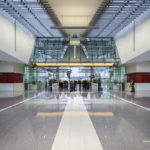
Somewhat boldly, vivid orange has been used to colour the walls on one side of the foyer. Complimenting that is a timber-clad ‘edifice’ which forms the basis of the mezzanine above. Aside from the orange walls on one side, the only other colour comes from the steps which are also orange, making them very easy to locate. Muted tones are used across the rest of the space, and a large floor-to-ceiling window provides ample natural light as well as a view to the Yarra River.

The orange of the foyer hints at what lies upstairs. Making one’s way to the mezzanine above, the walls, floors and ceiling are coloured in the same vivid orange. So whilst it sounds absolutely hideous, it works exceptionally well. I think the boldness of the colours work where a more restrained application of colour would have seemed almost tokenistic.

Clearly the architects and interior designers don’t want to over-do it, so only the mezzanine uses such a rich colour scheme.

Of course, the centrepiece of the Melbourne Convention Centre is the 5000-seat auditorium, which can be divided into acoustically-independent smaller sections. The auditorium is beautifully fitted out with comfortable chairs in various shades of earthy green reflecting the colours of the Australian bush. The upper walls and ceiling are clad in timber. As would be appropriate in such a venue, the designers have steered away from vivid colour in a space where people need to feel comfortable but can also concentrate on the speakers or performance.

In terms of utility, the stage can be clearly seen from all sections of the auditorium and for the purposes of a scientific convention, the acoustics were good. (I cannot comment about its suitability for musical performances or other applications).

I have just two criticisms about the design of this building.

My first criticism relates to the entrance, or rather the section that joins it to the older “exhibition centre”. This space is pierced from the posts supporting the balcony of the older building. I find the entrance narrow and pokey, but perhaps this was the intention of the architect but I don’t think it works well.

My other criticism is of the meeting rooms which, whilst comfortable, are aesthetically bland – a disappointment after experiencing the impressive design elsewhere!

The mezzanine (right) with foyer below.

The Melbourne Convention Centre was designed by Woods Bagot and NHArchitecture and built by a consortium led by Brookfield Multiplex and Plenary Group. The centre has a 6-star rating and has won multiple architectural awards. Deservedly so, in my opinion!

Great architecture makes for a great venue, so I am pleased that I have now had the opportunity to see the inside of Melbourne’s newest conference venue.

Time for Heritage Action

architecture, heritage, politics | Posted on August 15th, 2010 2 Comments »

I have been arguing about the need to protect Melbourne’s heritage architecture in The Grapevine for years. In recent times, it has appeared that the State Government and particularly the Victorian Heritage Council are far more interested in “job creation” than “heritage protection”. Three recent examples highlight the immediate problem at hand: the demolition of Lonsdale House, the gutting of Hamer Hall and the proposed 40% demolition of the Windsor Hotel.

Yet these are the tip of the ‘iceberg’ of destruction that is likely to hit our city in the coming year.

Thankfully, I am not the only person concerned about taking some action to defend Melbourne’s built heritage.

In recent times, a new advocacy group called Melbourne Heritage Action has been formed, and I am proud to say that I am a founding member. Many of the people involved with Melbourne Heritage Action were previously associated with the Save Lonsdale House movement (I am not one of them). Whilst the group is still in it’s infancy, I am impressed with the breadth of expertise we have pooled, as well as the broad community support. Even the National Trust has come on board to lend a hand, which is fantastic! Community interest is growing, too.

The Windsor Hotel

Melbourne Heritage Action seeks to promote an awareness of Melbourne’s built heritage, using a range of social media,  public submissions, public campaigns and demonstrations, where need-be. Through these mechanisms it is hoped that we will raise community awareness, which will entice the State Government (and other responsible agencies) to place a greater value on heritage protection.

At present there is a lot of work to do.

The beautiful Equity Trustees building stands to be gutted and altered, the Spencer Street Power Station is about to be skewered by the legs of a skyscraper which will stand over it, and the Scots Church Hall and Melbourne’s first multi-storey car park are to be levelled, but only if the developers get their way.

Melbourne Heritage Action founding members (L-R): Helene Athanasiadis, Katrina Grant, Rupert Mann (President), Adam Dimech and Jim Barrett. (Image: The Age)

In an election year that has also been witness to the Planning Minister’s questionable handling of the Windsor Hotel saga, there is considerable public interest in heritage and planning matters. Today, the Sunday Age has published an online article about Melbourne Heritage Action, which I hope will help garner further interest from the public.

If you’d like to help defend Melbourne’s significant buildings, and raise community awareness about planning and heritage matters in Melbourne, go to the Melbourne Heritage Action website at http://www.melbourneheritage.org.au/.

If you think you can make a contribution or want to become more deeply involved, please send an email.

We’d love to hear from you!

Hamer Hall: Before the Facelift

architecture, art, heritage | Posted on July 21st, 2010 11 Comments »

Three weeks ago, Melbourne’s famous Hamer Hall hosted its final concert before closing it’s doors to make way for a $128.5 million renovation, funded by the State Government.

Originally known as the Melbourne Concert Hall, the complex was designed by Sir Roy Grounds and opened in 1982 after a lengthy land dispute with the City of Melbourne, ongoing engineering problems and industrial action that had hampered its construction for several years.

The exterior of Hamer Hall, illuminated at dusk

After its opening, the Melbourne Concert Hall became a much-loved cultural hub, playing host to the world’s finest performers, orchestras and groups from Australia and abroad.

Whilst the Melbourne Concert Hall wasn’t very striking from the outside, the interior was fitted-out by expatriate designer John Truscott, who created a distinctive and luscious environment in which the public could enjoy a ‘special night out’ in the city.

Cadbury-Schweppes Room

John Truscott’s opulent interiors are very special: The colours have been very carefully selected to create a rich atmosphere (a signature trait of Truscott’s).

From the box office with its gold-leaf ceiling to the lobby spaces with their rich red carpet or the verdant green of the Cadbury-Schweppes Room, Truscott created unique and distinctive interior spaces that contained only the finest of furnishings and fittings. The use of padded leather as a ‘wallpaper’ in many of the corridor spaces is certainly something I have never seen elsewhere, but suited the building extraordinarily well.

Sadly, it seems that most of Truscott’s legacy is to be destroyed during the renovations.

The huge glass chandelier in the foyer, created by Michel Santry and called Arcturus, is to be removed permanently. And if  the official preview images are anything to go by, there won’t be much of Truscott’s work left when the renovation is complete. The Victorian Arts Centre website states rather vaguely:

“The important contribution made to the interiors by interior designer John Truscott has been a key consideration in planning the redevelopment of Hamer Hall. The proposed changes to the interiors, both in the foyers and the auditorium, have been arrived at following considerable thought and care to ensure that the existing interiors are retained as much as possible”.

I don’t see much evidence of this.

Illustration of the planned refurbishment of Hamer Hall

Last year I made a detailed photographic study of Hamer Hall as part of Melbourne Open House. Recognising the significance of Hamer Hall’s interior architecture, and suspicious that the State Government would trash yet another of our modern architectural masterpieces in it’s never-ending quest for the “modern” , I made a studious attempt to capture the essence of Hamer Hall, before it was all destroyed.

And destroyed it will be.

The original plans showed a horrible glass shard that would pierce the rear balcony to create a new entrance, but the latest renders seem to have omitted this particularly ugly feature.

The latest render of the redeveloped Hamer Hall.

We can’t halt progress forever, but it seems a tragedy to me that we care so little about mid- to late- 20th century interior design. The National Gallery of Victoria had it’s interior destroyed, now it seems to be Hamer Hall’s turn. I wonder what we’ll have left from this period, if even John Truscott’s work is not considered significant enough to preserve?

Some pictures, for posterity:

Madden approves Windsor redevelopment

architecture, heritage, politics | Posted on March 18th, 2010 6 Comments »

It is with deep sadness that I advise readers of The Grapevine that the Minister for Planning, Justin Madden, has approved the hideous Windsor Hotel redevelopment that I wrote about in October.

After the fiasco surrounding a leaked government memo that revealed a plot to hold a “sham public consultation“, approval from the Minister already seemed like a fait accomplis. Then last Wednesday (16 March 2010), the Heritage Council of Victoria granted approval for the redevelopment plans, subject to various revisions. So it came as no surprise when the Minister made his announcement today.

The following ABC News Victoria clip outlines the whole saga beautifully, including the Minister’s woeful performance at today’s press conference.

I won’t outline my objections to this project again, as they’re already outlined in my previous blog post.

I’ll just reiterate my disappointment at the vandalism that’s about to be wreaked upon the grand Windsor Hotel. I made the effort to write a lengthy submission to the Heritage Council, objecting to this proposal, but it seems it was in vain. Nevertheless, they have removed some of the “rough edges” from the design, which is of some value.

To those in Melbourne, I say enjoy this view, one last time… because it won’t be there for much longer.


Recent Comments...

  • bella said: “I am doing a assesment on the umpherston sinkhole and this infomation is really useful! With the history and the photos ...”
  • Adam Dimech said: “Thanks for your comments, Andrew. I think April Fools' Day is named for all such fools, just as Mothers' Day is name...”
  • Andrew said: “(not attempting to take great care with construction) I am not sure I agree with your first point. Isn't saying 'you've'...”
  • Jo said: “Visited Strahan Tasmania. one of those onsite cabins (stayed in heaps around over time never a problem). The place was g...”
Contact

Contact Adam Dimech

To contact me, please use the

Feedback Form

or send a message via the following social media:


Facebook Flickr GooglePlus Twitter