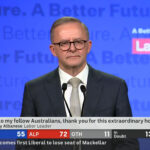
In what has possibly been the tightest election in Australia’s history, the country seems headed for its first-ever hung parliament.
Prime Minister Julia Gillard, who ousted Kevin Rudd in a party room coup a mere 8 weeks ago because of popularity concerns, may go down in history as the politician who made Australia’s worst-ever political decision.
Her unpopular grab for power may have cost her government.
Will Tony Abbott become Australia’s next Prime Minister? (Picture: ABC Television)
As I write, the Australian Labor Party has won 70 seats and the opposition Liberal/National Party coalition has 72 seats. The Greens have won 1 seat, and independents have 4 seats in the 150-seat parliament. The remaining seats remain uncertain.
Depending on how the final numbers tally, and depending on which party the independents support, we may have a hung parliament. It is impossible for the Liberals to govern in their own right because they would also need the support of some independent MPs on the floor of parliament.
The predicted Australian Parliament. (Picture: ABC Television)
Australia has had a minority government once before. In 1939, Robert Menzies’ United Australia Party formed a government with Country Party support. In that instance, the minority government was the product of changing allegiances in parliament, rather than an election.
If the final tally from the 2010 election delivers a hung parliament, the Governor-General will ask one of the party leaders to form a government, before testing their confidence on the floor of parliament. If that party cannot garner majority support, the other major party leader will be asked. If the numbers are still balanced, then the Governor-General will have no choice but to call another election and ask the people to decide again.
One must ask: Would a minority government work in Australia?
Sometimes minority governments work out well, sometimes they don’t. The Labor Party is running a minority government with the Greens in Tasmania, following their election of a hung parliament earlier this year. So far, that government has been a success (in a constitutional sense).
Live coverage of the election was broadcast on ABC1 and ABC News 24
Personally speaking, I believe that a Labor minority government is the most likely outcome, with support from the Greens and some of the independents.
Given that the Greens are essentially an environmental-socialist party and the Liberals/Nationals represent the centre-Right, I don’t believe that a coalition between the two is sustainable. Since the Greens and Labor are both left-wing parties with various policy overlaps, a coalition between the two could work. Whether the ALP would give Greens MP’s any ministries is another matter, but that is the convention in such a situation.
Because of the tight results, it’s unlikely that the Australian Electoral Commission will be able to finalise the results for several days. In the interim, I expect that the independents will be receiving a lot of phone calls from Julia Gillard and Tony Abbott
Many have lamented the dullness of this campaign. Few would have expected such an ‘exciting’ outcome.
I have been arguing about the need to protect Melbourne’s heritage architecture in The Grapevine for years. In recent times, it has appeared that the State Government and particularly the Victorian Heritage Council are far more interested in “job creation” than “heritage protection”. Three recent examples highlight the immediate problem at hand: the demolition of Lonsdale House, the gutting of Hamer Hall and the proposed 40% demolition of the Windsor Hotel.
Yet these are the tip of the ‘iceberg’ of destruction that is likely to hit our city in the coming year.
Thankfully, I am not the only person concerned about taking some action to defend Melbourne’s built heritage.
In recent times, a new advocacy group called Melbourne Heritage Action has been formed, and I am proud to say that I am a founding member. Many of the people involved with Melbourne Heritage Action were previously associated with the Save Lonsdale House movement (I am not one of them). Whilst the group is still in it’s infancy, I am impressed with the breadth of expertise we have pooled, as well as the broad community support. Even the National Trust has come on board to lend a hand, which is fantastic! Community interest is growing, too.
The Windsor Hotel
Melbourne Heritage Action seeks to promote an awareness of Melbourne’s built heritage, using a range of social media, public submissions, public campaigns and demonstrations, where need-be. Through these mechanisms it is hoped that we will raise community awareness, which will entice the State Government (and other responsible agencies) to place a greater value on heritage protection.
At present there is a lot of work to do.
The beautiful Equity Trustees building stands to be gutted and altered, the Spencer Street Power Station is about to be skewered by the legs of a skyscraper which will stand over it, and the Scots Church Hall and Melbourne’s first multi-storey car park are to be levelled, but only if the developers get their way.
Melbourne Heritage Action founding members (L-R): Helene Athanasiadis, Katrina Grant, Rupert Mann (President), Adam Dimech and Jim Barrett. (Image: The Age)
In an election year that has also been witness to the Planning Minister’s questionable handling of the Windsor Hotel saga, there is considerable public interest in heritage and planning matters. Today, the Sunday Age has published an online article about Melbourne Heritage Action, which I hope will help garner further interest from the public.
If you’d like to help defend Melbourne’s significant buildings, and raise community awareness about planning and heritage matters in Melbourne, go to the Melbourne Heritage Action website at http://www.melbourneheritage.org.au/. If you think you can make a contribution or want to become more deeply involved, please send an email. We’d love to hear from you!
After the fiasco surrounding a leaked government memo that revealed a plot to hold a “sham public consultation“, approval from the Minister already seemed like a fait accomplis. Then last Wednesday (16 March 2010), the Heritage Council of Victoria granted approval for the redevelopment plans, subject to various revisions. So it came as no surprise when the Minister made his announcement today.
The following ABC News Victoria clip outlines the whole saga beautifully, including the Minister’s woeful performance at today’s press conference.
I won’t outline my objections to this project again, as they’re already outlined in my previous blog post.
I’ll just reiterate my disappointment at the vandalism that’s about to be wreaked upon the grand Windsor Hotel. I made the effort to write a lengthy submission to the Heritage Council, objecting to this proposal, but it seems it was in vain. Nevertheless, they have removed some of the “rough edges” from the design, which is of some value.
To those in Melbourne, I say enjoy this view, one last time… because it won’t be there for much longer.
I care a lot about this issue. As a person with a deep concern for the health of the environment as well as the health of our agricultural sector, water policy is of particular interest. I have written previous blog posts documenting rainfall patterns, El Niño and the drought. Given the importance of water to Australia, the driest inhabited continent, I expect water policy decisions to based on science and data, not politics.
Unfortunately, I have a suspicion that today’s announcement that Stage 3A would be reduced to Stage 3 has a lot more to do with politics than science. Here’s why:
Let’s look at the data. Shown below is a graph illustrating the overall amount of water stored in Melbourne’s reservoirs as a percentage of total reservoir holding capacity at this time of year, for the past decade. The data has been taken from Melbourne Water, who publish weekly statistics in their Weekly Water Report.
Melbourne’s total water storage levels as a percentage of capacity on or around 16 March for the past 10 years. The period where “Stage 3A” restrictions have been in place is marked in red. (Data supplied by Melbourne Water Corporation, based on readings from Cardinia, Greenvale, Maroondah, O’Shannassy, Silvan, Sugarloaf, Tarago, Thomson, Upper Yarra and Yan Yean reservoirs.)
The graph clearly illustrates a drop in Melbourne’s water from 2007, but Melbourne’s water supplies had been dwindling prior to that. As a response (and in accordance with legislation), Stage 1 water restrictions were introduced on 1 September 2006 after that year’s dry winter. As the effects of the drought continued, Stage 2 restrictions were introduced on 1 November 2006, and Stage 3 commenced on 1 January 2007.
Then a curious thing happened.
Just as it appeared Melbourne would head into Stage 4 water restrictions (which would prohibit almost any outdoor water use), the then Premier, Steve Bracks, announced the creation of a new level: Stage 3A. Unlike Stage 4 (which was in place throughout much of the state, and in the city of Geelong), Stage 3A still allowed some watering of plants. But the real change in water policy was not the creation of Stage 3A, but how the restrictions were decided in the first place.
Up until that point, the various government water authorities made a decision about implementing water restrictions as per the Water Industry Act 1994. Whilst each decision about water restrictions had to be approved by the Minister for Water, the actual decision rested with the various water authorities who were at arms-length from government. This is detailed in the Victorian Uniform Drought Water Restriction Guidelines (PDF) which clearly specifies four water restriction levels (ie. Stages 1, 2, 3 and 4).
In 2007, the Premier announced thatthe government would make the decision about water restrictions in Melbourne in consultation with the water authorities. Suddenly, there was a chance for politics to enter the decision-making process, and suddenly Stage 3A was born.
Look at that graph again. You will notice that water storages were at 33.0% on 15 March 2007, just before “Stage 3A” was announced. Now, three years later, the levels are 34.6% and 3A is to be abandoned for Stage 3.
A paltry 1.6% more water seems to be the difference between Stage 3A and Stage 3. I wonder what threshold was crossed in that small rise? According to Yarra Valley Water’s Drought Response Plan (PDF), no threshold was crossed.
The table below is taken from Schedule 1 (p.8) of Yarra Valley Water’s Drought Response Plan. It shows the “trigger levels” for the four legislated stages of water restriction. You will notice no mention of “Stage 3A” in this document, any other water authority’s Drought Response Plan, in the Victorian Uniform Drought Water Restriction Guidelines or in the Water Industry Act 1994.
What you will note is that the trigger for Stage 3 water restrictions in March is a storage volume of 629 GL (gigalitres). Our current water storage is at 34.6% full, equivalent to 626 GL. Technically, this means we should be on Stage 2 restrictions!
Of course, this can’t really happen. The dams need to re-fill after dry periods, before we can reduce restrictions. We also need to ensure that Victorians learn from the experience of the drought, rather than redeveloping ‘bad habits’. The Victorian Uniform Drought Water Restriction Guidelines and Water Industry Act 1994 both provide for consideration of these factors.
Those published documents mandate that water authorities must consider how quickly the reservoirs are refilling, patterns of consumer water consumption, recent climate patterns and predictions of future rainfall before reducing restrictions. In addition, the Drought Response Plan for each of Melbourne’s various water authorities actually provides a very sensible scientific evidence-based decision-making process.
Unfortunately this system has been corrupted by a State Government only too keen to use water policy to secure votes.
In its defence, the State Government had cited the commissioning of the (much hated) North-South (Sugarloaf) Pipeline, the ‘success’ of Target 155 and the construction of the Wonthaggi Desalination Plant as reasons to remove Stage 3A restrictions. I don’t wish to make comment on these various policy decisions nor their effectiveness, other than to remind you that there’s been no real change in water storage levels between 2008 and 2010 to justify a change in water restrictions.
The truth is that in Victoria, the setting of water restrictions is a complicated process described variously in Drought Response Plans, the Water Industry Act 1994 and the Victorian Uniform Drought Water Restriction Guidelines. It is my view that the Water Industry Act 1994 should be amended so that: (1) Trigger points are clearly published in law; (2) The decision about the imposition and removal of water restrictions are made independent of government; (3) that government water authorities are given legislative independence from government; (4) environmental considerations and consumption behaviour be considered in the decision-making process and (5) only the Governor of Victoria may revoke decisions.
It is only with these measures that we can have full confidence in the impartiality of water restriction decisions.
Feathers were thoroughly ruffled yesterday when the Commonwealth Government released a report entitled The Future of Sport in Australia(also called the “Crawford Report”), which examined the government’s funding of elite sports.
Rather than supporting a funding increase, the report’s author David Crawford said the money would be better spent elsewhere, and rejected the Australian Olympic Committee’s request for an additional $100 million in funding per annum.
Predictably, it didn’t take long for a response from the President of the Australian Olympics Committee, John Coates, to crudely declare that he was “pissed off” at the report’s findings. For if there’s one faux pas in Australia, it’s to question the supremacy of sport.
Regardless of such sensibilities, I feel it’s about time we took the axe to elite sports funding in Australia.
Sport is a worthy endeavour. Participation brings considerable health and social benefits to those who engage in it’s many offerings, and elite sportsmen and women provide inspiration for people to give sports a try. Since Australia is now the world’s fattest nation, we need to do all in our power to prevent a looming health crisis.
Yet the current strategy of throwing bucket-loads of taxpayers’ money at the Australian Sports Commission clearly isn’t working in creating a leaner and fitter nation. Nor is it delivering Australia more Olympic gold. Since the 2000 Sydney Olympics, our medal count has been falling whilst at the same time we’ve collectively become fatter.
Exhibiting a vulgar form of sports blasphemy, David Crawford went as far as suggesting that Olympic gold medals are not the best way of measuring sporting success and described Australia’s aim of being one of the “top five” Olympic nations as “unrealistic”. With comments like that, we’ll no doubt hear calls to “crucify him!” as the angry mobs coalesce!
The Australian Sports Commission was established after the 1976 Montreal Olympics where Australia didn’t win a single gold medal.
The strategy seemed to work, because in time our Olympic performance improved considerably, culminating in the 2000 Sydney Olympics where Australia won 16 gold medals. Yet gold medals come at a cost. In the 2007-8 financial year, the Australian Sports Commission received $216 million in government funding (source). The Crawford report estimated that each Olympic gold medal cost $15 million, although it was a guess because there is apparently little accounting or accountability in Australian sport.
In fact, there are some of us who don’t have any interest in sports, and resent so much of our taxes being spent on people who contribute almost nothing to our nation.
Students who enrol in university, perhaps to study science, engineering, economics, medicine, law, or teaching have to pay a considerable percentage of the cost of their education. Yet when they graduate they make a considerable contribution to our society by educating our children, designing our cities, developing our medicines, helping us understand our environment, crafting our laws, securing our economy or looking after us when we’re ill. People who enter TAFE to study trades, also have to pay considerable fees.
Yet sports people, who spend their time kicking balls across fields, throwing sticks at targets, or running in circles, receive their training for free. And whilst a university student has to repay his debt after earning a paltry $21,000, a sportman can earn millions and still not pay a cent.
John Coates, chief of the AOC, described the Crawford Report as “an insult”. At an angry press conference, he asked “Is Mr. Crawford suggesting that medals won in Beijing last year by Matthew Mitcham in diving, Steve Hooker in pole vault and Ken Wallace (kayak) meant nothing to the Australian people? Is he telling us gold medals won by the rowers and sailors in Beijing meant nothing?”.
To suggest that offending Olympic athletes is sufficient reason not to cut the sports budget is ludicrous, whilst Coates’ labelling of the report as “un-Australian” smacks of desperation.
In 2007, the Commonwealth Government slashed $63.4 million from the CSIRO budget. One could call the CSIRO the “Olympic team of Australian science”, as our nation’s premier research organisation. As a result of the cuts, more than 100 jobs were lost and two centres closed.
As a scientist, was I offended? Who cares!
My emotional response (or that of those affected) is irrelevant to a discussion about whether it was a good decision or not. The effect on the nation, supported by data, should be the primary influence on any non-welfare public financial debate.
It is well time that athletes were compelled to pay for their training. It is also time that we dropped our obsession with Olympic gold medals. Instead, we should re-invest our tax dollars into community sport, so that ‘ordinary Australians’ can participate, and gain tangible health and social benefits from their activities.
Winning Olympic gold might momentarily bring a warm feeling to our hearts, but aside from its role as popular entertainment, neither the Olympics nor elite sport in general contribute much to Australian society.
If holding such a view makes me un-Australian, so be it.
The calling of names will never convince me that sport is deserving of such generous quantities of taxpayer dollars, whilst our hospitals are under-funded, our trains arrive late and our poor sleep on the streets.