Clyde Cameron College
The tumultuous architectural and political history of one of Australia’s oddest buildings.
In July 2008, the Royal Australian Institute of Architects awarded its “25 Year Award for Enduring Architecture” to the former Clyde Cameron College building in Wodonga, Victoria.
The citation provided an opportunity to look back at the College’s inception and later demise, both architecturally and politically, since the college was mired in controversy from start to finish.
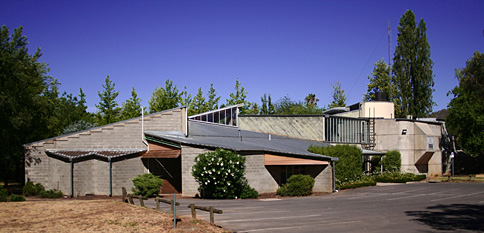
A Chaotic Structure
I visited the Clyde Cameron College site in January 2009. I’d read about it in The Age and via the RAIA but had never seen any photographs of it.
When I finally saw it for myself, I was initially confused yet also somewhat impressed; confused because of the eclectic array of buildings but impressed at the boldness of the design.
Clyde Cameron College (as I will refer to it) consists of an array of small satellite buildings arranged around a central administration centre. All of the buildings are linked by enclosed corridors, and the whole complex is composed of concrete, steel and glass. The front porte-cochère is a heavy mass of off-form concrete, with a smaller concrete tunnel leading visitors into the main reception. From there the rest of the College sprawls.
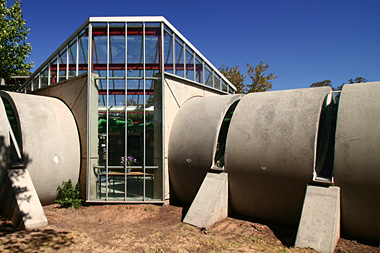
Taking a walking tour of the site, I could see how each component of the College contributed to the whole. In some cases, the design was more coherent than others, but at each turn my interest was aroused. Small classrooms were linked to apartments by enclosed glass corridors. Rooms were designed with jarring shapes, and a variety of textured concrete and besser bricks has been utilised.
Kevin Borland’s influence in the design of Clyde Cameron College is abundantly apparent, with many stylistic reminders of the Harold Holt Memorial Pool. Yet the design of the College is far more adventurous than Borland’s earlier work and contains far more detail, even if that detail consists of various rounded or square ‘chunks’, tubular tunnels and curved stairwells in keeping with the béton brut ideal.
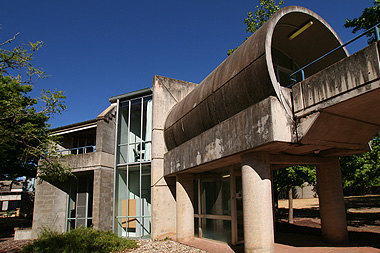
As I strolled, I could feel the complex coax me further, if for no other reason than to see what architectural absurdity would be encountered next. I was not disappointed, for the absurdities were in heavy abundance.
It’s Time. Maybe.
As intriguing (and confusing) as the Clyde Cameron College complex is, the rise and fall of its tenant organisation, the Trade Union Training Authority (TUTA) is as chaotic and brutal as the building that housed it. Brutalist architecture was wrapped in ideology, and understandably, so was TUTA.
TUTA was established under the Trade Union Training Authority Act 1975; a hasty attempt by the Whitlam Labor government to establish such an organisation before the government was thrown out of office.
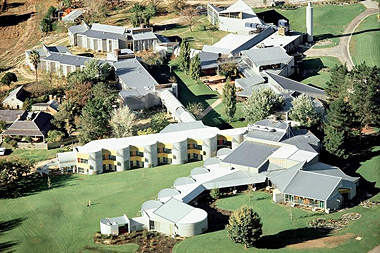
Named in honour of the then-serving Minister for Labour, Clyde Cameron College was to provide participant-centred approaches to adult education courses which were ideologically and politically independent from individual unions and the Commonwealth Government. To achieve this, academics from the Centre for Continuing Education at the Australian National University guided the development of the curriculum in those early years.
The incoming Fraser Coalition government gave begrudging support for the establishment of TUTA, but only agreed to continue the building of the College on account of its status as being politically neutral.
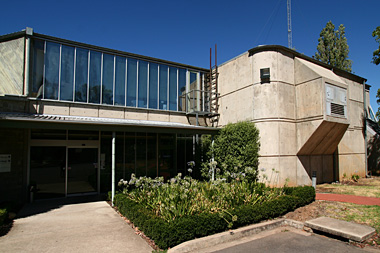
Because of the tumultuous political environment of the 1970’s, TUTA didn’t believe that it’s funding for the project would be secure if there was a change of government. Hence, in what would be considered a scandalous affront to public administration today, the contract for building Clyde Cameron College was tendered at the design sketch stage. Construction was commenced in haste with the priority being that construction should be as advanced as possible as soon as possible, despite the lack of detailed architectural drawings and plans. It should come as no surprise that a massive budget blow-out occurred. A $3 million project quickly became a $6 million project.
Given the client, it was agreed that the building should be used to express the trades and craftsmanship of the builders who constructed it. Brutalism was believed to be the best way to fulfil that ideal.
Today, it could be seen as an absurd concept that a “raw” and “unembellished” building should showcase trade skills, but in the 1970’s that made good sense. And so it was that the Clyde Cameron College was eventually built.
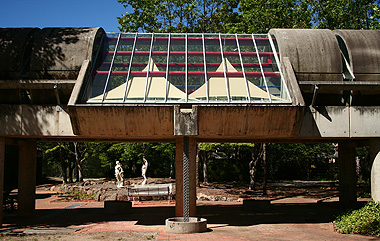
Kevin Borland was proud of his team’s work in designing and building Clyde Cameron College, believing that he’d created an architectural masterpiece. Borland submitted his design to the Royal Australian Institute of Architects (RAIA) in 1979 but received no award, as he later wrote with notable bitterness, in Architect magazine in 1982:
(Clyde Cameron College) was adjudged on completion in the 1979 Awards for the Building Awards, two architects regarding it as the best building of 1979, and two non-architects as the worst with the chairman not exercising his casting vote, hence it received no award, not even a citation. It has subsequently received a great deal of publicity overseas and is now the source of numerous visits by International Trade Union authorities.
It wasn’t until 2008 that the RAIA finally acknowledged his work with an award for enduring architecture.
In Accordance with Change
The first years of TUTA’s existence were a success. Aside from Clyde Cameron College, TUTA had campuses in each state and territory capital city which operated in a semi-autonomous manner. Enrolments rose, and feedback from students was positive.

However, according to Voll (1997), things changed when the Prices and Incomes Accord was enacted and the Australian Council of Trade Unions (ACTU) started having direct involvement in the operations of TUTA.
I won’t detail those changes here, but suffice to say that the curriculum was changed at the insistence of the ACTU. As the union movement started to view TUTA as one of its own tools, the Accord was to be uncritically endorsed in the curriculum. Also at the insistence of the ACTU, the method of teaching changed from participant-centred to instructive. According to Voll (1997), enrolments and student satisfaction fell, especially when key courses were abolished and replaced with arguably partisan subject matter.
This change meant that the support which TUTA had received from the Coalition had evaporated. Abolition of TUTA was proposed as policy in John Hewson’s Fightback! campaign of 1993, and finally enacted when John Howard was elected to government in 1996. The Liberal Party believed that taxpayers’ money should not be used to advance the cause of unionism.
That year, the affairs of TUTA were wound-up and the Clyde Cameron College was closed. The building was sold to private owners, who used it as the basis for establishing the Murray Valley Private Hospital.
As it Currently Stands
Fortunately, and despite its tumultuous past, the Clyde Cameron College building remains largely intact, save for a small extension on it’s northern side. Given that the building was designed as a residential college, its transformation into a hospital has been remarkably successful.
That said, the building has not aged well, as is common for many Brutalist buildings. The concrete, most especially on the tunnels, has become stained with black grime and requires cleaning. The gardens, which were once so well maintained have been allowed to disintegrate on many parts of the site.
Not long after I visited the Clyde Cameron College in January 2009, the Heritage Council added the building to the Victorian Heritage Register.
With its controversial political past, it’s hastily-executed construction and it’s status as a unique example of Australian Brutalist architecture, I hope that funds will be made available to perform some restorative works on a unique Australian building.
References:
- Borland, K. (1982) Projects in the Albury-Wodonga area. Architect, August, p. 17
- Cupper, L. (1980) Public funded trade union education in Australia. Industrial Relations Journal 11 (1): 57-68.
- Day, N. (1977) Essential Speed. Architecture Australia 66 (1): 78-82
- Evans, D. et al. (2006) Kevin Borland: Architecture from the Heart. Royal Melbourne Institute of Technology Press, Melbourne, Australia. ISBN: 9781921166204
- Hutson, A.E.W. (2003) ‘Architects Group and the pipe dreams of Clyde Cameron College’ in Gusheh, M. & Stead, N. (eds), Progress: The proceedings of the twentieth annual conference of the Society of Architectural Historians, Australia and New Zealand. pp.158-162. Sydney, Australia.
- McDougall, M. (2009) Adding to the recent past: Challenges in distinguishing new work from the not so old. Proceedings of the ‘(Un)Loved Modern’ Conference. Sydney, Australia. [Full Text]
- Szego, J. (2005) To be Brutal, our modern heritage is set in concrete. The Age, 23 December, p.8
- Voll, G.R. (1997) Time’s up for TUTA – A Corporatist Casualty. Proceedings of the Association of Industrial Relations Academics of Australia and New Zealand Conference. pp.592-599. Brisbane, Australia. [Full Text]
Comments
18 responses to “Clyde Cameron College”
Yep, definitely reminds me of Harold Holt too.
(By the way, your pics don’t show in Google Reader.)
Thanks Daniel for the heads-up re Google Reader. I’ll take a look and see what’s going on there.
I am proud to have been a student at this unique college.As a shop steward in the 80s public speaking and media exposure can make representatives of either union or employer groups timid in their approach to a task of presentation in their speach. This college gave help and support when approaching employers on issues.I submitted a log of 10 claims to my employer and won all.Never done previously.eg Work clothes clean hot water for showers [prev rusty]15min morning tea prev 10min and lastly 10 mins shower time.On a seperate issue hearing protection a heavy enginnering industry. Tell me where this training can now be achieved by those who require help.Bring back the college.
I was once in Clyde Cameron College (1993), course advocacy.
Surprised me when I read this article, so sad, a place where we could study and meet people around the world although with a two to three weeks courses. When I was there, I met friends from Australia, Tonga, Pacific Islands.
Well, thanks to TUTA and all the Unionist who make this college proud at one time.
I too did a 2 week live-in advocacy course at CCC in the early 90s. Ironically I later became an organiser for all TUTA employees. Great days and a unique building.
Dear Dave,
If I’m not mistaken we are together in Advocacy Course….I still remember Rina Churchill from Quensland, Crist from Melbourne, check your album, maybe you can recall the last day of the course, we had our group photos…
Cheers..Merry Christmas.
I was looking at my old pictures and I found one where I was a participant for a 10-day live-in seminar on trade union education somewhere in Wodonga, Australia. I was still in the Philippines when my employer, the Trade Union Congress of the Philippines sent me as our representative. I moved here in the US a few months after the seminar. It was in 1990 and I can’t remember anymore the exact venue but I remember it was sponsored by TUTA (I will not forget that word because it means puppy in the Philippine language). I googled TUTA and I found out that I stayed in Clyde Cameron College. After more googlings, I found websites referring it as the former Clyde Cameron College, and alas, it was transformed into a hospital now. As soon as I saw the pictures, everything came back to me, the memories of my 10 day stay there on a spring season I believe. I remember then than that building looks so new then, but I had difficulty finding my way from my room to the conference rooms and teh cafeteria and back because it looked like a maze to me then. (Well, I already have difficulty finding my way anyway and this confused me more). It’s great to know though that I’ve stayed in this unique building which was just honored recently. Hopefully it will be restored and preserved for years and the future Australians will have a chance to see this unique building.
I remember well my two week course there in 1981 representing AMPSSA. Brilliant place, fantastic experience, but the architecture was something else. People asked me why so many photos were just of bits of building …. you had to be there….
I did a two week course there in Enterprise Bargaining in 1992. (The week that the 3 tenors were broadcast live on the ABC for the first time)
The buildings looked a whole lot cleaner then, and I was actually impressed with the building, but I must agree that the courses were hijacked by the ACTU and Labor by then as it was heavily weighted to show us how to convince members that Enterprise Bargaining was better than Paid Rates Awards, and that the Prices and Incomes Accord was the way to go. It was also obvious that the teaching staff did not support this shit they were forced to spruik.
On my course was a dude from PNG, 1 from the Snowy Mountains Hydro, some from Victoria, some Train Drivers from the Pilbara, and us CSA delegates from Perth.
Loved the kitchen.
I was told then that you could use the college like a hotel for the occasional stay.
I had a great time at various TUTA courses in that wonderful building in the late 1980s-1990: getting to know unionists from around Australia and around the world, arguing about various Accord proposals, working with other research officers on our research and other skills, etc etc. I brought my then two year old son along for one course – the College organised a place in a local childcare centre, and he enjoyed his evenings (and breakfasts) with all the course participants. Thanks, Adam!
(I found this site when I googled ‘Clyde Cameron College’ after receiving an email from a NZ unionist I have not been in touch with many years, who reminded me that we first met at Clyde Cameron College – and she asked after my son…)
Thanks Adam for a good well researched article which brought back many fond memories.
I was President of the Victorian Printers Operatives Union (representing employees on the major newspapers) when I attended my first residential course at the College around 1983/4, having previously attended courses at the Victorian centre located in a lovely old (Heritage listed I think) terrace building in Drummond Street Carlton.
Interestingly there was another course being conducted at the same time, to do with media studies as I remember, and as part of their course they were required to produce a daily newspaper for distribution.
In keeping with the architecture it was cleverly named “The Pipeline”
Some wags and I started up a satirical version in opposition which we called “The Drain”
I subsequently attended a course designated “Train the Trainer” as I recall, being by this time a Training Officer in the Victorian Centre.
I cannot comment too much on the politicisation of the organisation which would appear to have occurred after I had moved on.
However I can attest to the great value it provided in training union representatives in many aspects which contributed to their on the job abilities.
Public Speaking, Negotiating, Occupational Health and Safety (just taking off so to speak with the introduction of the OH&S Act), workplace inspections, research and other topics not only fitted them for their roles, but also taught that objectives could be realised without industrial action of a disruptive kind.
I think the statistics of the time would verify that during the days of TUTA’s operation days lost through industrial action were very low. Of course much of this must be attributed to the Accord, which obviously restricted the types of disputes that could arise. As for “student dissatisfaction”, I cannot recall conducting a course which didn’t receive the highest ranking feedback, which was also common among my colleagues.
But I feel that it was the training of representatives to handle the macro incidents at the “coal face” which put a human face on the Trade Union movement, such as Health and Safety related matters became more prevalent, such as RSI and many other office related problems that were appearing with new technology which were invaluable and a lasting legacy. Of course many unions now have their own training regimes and would have TUTA as their model even today.
It is worth noting that the dispute resolution training were not universally popular within the TU movement.
In fact I would say it was an endorsement that Norm Gallagher refused to send any delegates to any of the courses!!
Thank you again and it would be great to hear from any of my contemporaries from that enjoyable time.
Kind regards
Terry Falkingham
I was an Organiser for the Operative Painters and Decorators Union NSW Branch, and I attended the College in the late 1980’s and early 1990’s.
I have many fond memories of it and the people who attended. It certainly was a civilized opportunity for union officials to gather and develop and hone their skills. The library held some fascinating materials, I recall watching a video on the demise of Australian development and manufacture as industry would not get behind Australian discoveries and overseas countries took advantage of the fruits of our intellectual advancements. Also Menzies when Prime Minister handing over Australian development of arms and rocket discovery to the British. Not much has changed since then, just a quicker abandonment of Australian manufacturing.
My father in-law John (Jack) Edward Heffernan, who was eventually awarded an OAM, was a former Secretary of the Metal Workers’ Union, he stood against Bob Hawke in the running of the leadership of the ACTU. Jack then became a Commissioner of the Australian Conciliation and Arbitration Commission between 1973 and 1981, he was then later appointed as Chair of TUTA.
The political will at the time to make Australia a better place for all has certainly slipped our political leaders grasp sine the great man Gough Whitlam was politically assassinated by the conservative forces.
One can only imagine what these and other comrades will be stirring in the sky https://www.youtube.com/watch?v=AZQxH_8raCI.
Kind regards and memories of many former great trade union leaders and officials.
Bradley Beasley
I to attended the College in the 1980’s on several week long courses as a Delegate for the Australian Railways Union now the Australian Rail Tram Bus Union also at a National Council for the ARU.
it was a great training ground for Trade Unionists and it was a sad day and loss for the Trade Union movement when it was closed.
This was a great venue that allowed trade unionists and others to meet and develop their skills to enable better workplaces. It was a sad day when it closed. I met many Good Comrades there sharing experiences. I remember a conference there of all trades and Labour Councils from around Australia and I think the last director was Jenny Luck, who revigorated the North East trades and Labour Council in Wodonga, which is still going today.
I understand from an email I received that some people are doing a bit of history if TUTA as apparently an article published in the Sydney Morning Herald, last weekend, 3/4 November 2018.
A few years ago I visited CCC under its new operation!!
Thanks to all who made this such a Great place !
Peter
Hi Adam,
Are you still there? If so I would like to contact some of the people who have posted comments as part of a project: REMEMBERING TUTA. You can find out more about it by visiting the website: ssoa.com.au /TUTA Memories/Collection to date?
Would you be willing to send an email to the former participants mentioning REMEMBERING TUTA (and I realise some may have died or given up their email) adding:
An Invitation to Participate
You are invited to take part in a collection of reminiscences about your involvement in TUTA.
TUTA, the Australian Trade Union Training Authority (1975-1996), a Statutory Authority of the Australian Government was tasked to train union officials and delegates. It had centres in each State and a residential Clyde Cameron College in Wodonga. Several former staff and friends will develop a history of TUTA. Persons willing to share information about their TUTA experience are invited to write a short report or be interviewed with a focus on: training methods, training facilities, how the training impacted on their work and life, and memorable anecdotes. Photographs may be included. Interested persons please go to ssoa.com.au /Memories/Collection to date to see what we have gathered. And do, please submit material at the Submit your memories sub tab.
Phil Drew, Clyde Cameron College.
I attended several TUTA courses at Clyde Cameron College as an organiser for the Australian Insurance Employees Union during the early 1980s and I have many fond memories of my time there. A fortnight in the College would go by very quickly: learning, socialising and exchanging ideas with colleagues. It played an essential part in my development as a union official and everything I learned there has stood me in good stead since. I found the building a really fascinating and exciting place to be; I remember the play of light through the angled glass of the linking ‘tubes’, bright colours everywhere and the way the ramps ‘delivered’ us from one level to another. I spent a lot of time taking many photographs all of which are now sadly lost. The scale may have been cavernous but the atmosphere of the place was not. The bedrooms were comfortable and designed for study; quiet and somehow timeless. The whole place seemed to work perfectly in its purpose and felt like an oasis where everyone was there with a specific purpose. Seeing the recent photographs makes me a little sad; the building looks tired and in need of a lot of care. I remember it as a relatively pristine new building that welcomed me into the cavernous reception area every time I went there. I experienced the College as a haven.
I was twice at the TUTA representing the Solomon Islands Public Employees Union in year 1991 and in 1992. The college is a perfect institution that give skills and equip union reps from around the Asia and the Pacific Region . And l fill that something is missing to unit unions from the regions in sharing and learning the unions aspiration to have quality leaders and education . Today l have return to lead my union since 2015 to now. I wish to pay tribute to my tutors, Jenny Luck, Phil Drews, and many others who l cant remember them now but to say thank you all and PSI Educators programs that provides a path way to be successfully.
Robert
I was working in Kevin’s office at the time. The office on the top floor at 10 Peel Street Collingwood was a busy place in the 70’s. AG Architects Group (K.Borland, Max May, Phillip Cohen + Osric Spence) was a great place to work. There were many great projects over that period of time including Clyde Cameron College. Bernard Brown was the driving force behind the design and development of the building. The pressure was always on to stay one step in front of the builders, because the building started construction before most of the building detail drawings were completed.
John and Thurley O’Connor were onsite architects , I wonder if they are over the pressure they were under to this day.
Industrial Aluminex glazing bars were used for windows throughout the building. Phillip Cohen detailed every head, jamb and sill detail throughout the building, there were hardly any two the same, all at full size on A4 Sheets. The wall of A4 folders was immense.
I mentioned it was a great place to work. I was the father to a 3 year old at the time and mentioned to Kevin that I couldn’t be in on a particular day because I had to look after him, without a moments hesitation he said, “Bring him in we will all take turns looking after him”. It was that kind of place.
Michael.