The Green Rose
A genuine horticultural curiosity.
Have you ever seen a truly green rose, with flowers as green as the leaves? I am not talking of that faux variety some people are talking about, but the genuine article.
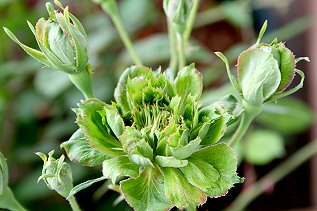
I speak of Rosa chinensis ‘Viridiflora’, a flower of which is photographed below. A truly Green Rose!
I am not a rose enthusiast. In fact I consider that most cultivars make for quite unattractive shrubs if one ignores the blooms. When I used to work in a retail nursery, customers would frequently come to me and boast of their roses. But secretly, I could never get past the reality that for a month’s flowers in summer, one has to look at a thorny leafless twig in winter and often a sparse leggy shrub in the warmer months. Personally, there are other plants I favour more.
What I do enjoy growing are unusual plants that arouse genuine interest in people, because they are uncommon; ‘novelty’ plants if you like. And the Green Rose is certainly one of these!
I purchased mine from a grower many years ago. So long ago in fact, that I cannot even remember the person from whom I bought it. But I do recall I had to search a vast number of nurseries in and near Melbourne before I could locate one. Many rose ‘specialists’ had not even heard of this cultivar. The nursery which supplied mine had sold all, except one. That single specimen was in such a poor state that eventually the nurseryman was compelled by his conscience to give it to me for nothing. After a considerable amount of time, I was able to nurse it back to health.
Rosa chinensis ‘Viridiflora’ (also known incorrectly as Rosa chinensis var. viridiflora) was reportedly first observed some time before 1743 and introduced into culture by the British nursery firm Bembridge & Harrison in 1856. (I don’t know when it was introduced into Australia). The Green Rose will grow to a height of 1 metre and similar width. Like all cultivated roses, it needs to be cut back hard in winter and propagation is by cuttings grafted onto R. multiflora rootstocks. There is no perfume derived from this species, and that is because of the flowers.
Green is a little unusual, wouldn’t you say?
The ‘flowers’ of the green rose are barely that at all. In fact it is a genetic anomaly that is presumed to be the key to the Green Roses’ existence. There is an abnormal process that sometimes occurs in plants, called phyllody. Phyllody is where some or all of the organs from the four wholes of a flower (sepals, petals, androecium or gynoecium) are replaced with leaf-like (vegetative) organs.
The development of flowers is controlled by ‘floral organ identity genes’, most of which belong to a class known by plant scientists as the MADS-BOX gene family. These come in three flavours, ‘A’, ‘B’ and ‘C’. You can read about them here. In essence these three classes of genes are believed to control the development of the four whorls of flowers in what is described as the ‘ABC Model’. If one of these genes does not co-operate, perhaps because of a transcription error or mutation, then the flower – or all the flowers – will be mutated.
Scientists have demonstrated this with Arabidopsis thaliana (mustard) by removing various combinations of floral identity genes and examining what the resultant flowers look like. Fascinating stuff, but I digress:
The Green Rose is a ‘model’ of the failure of this system because all of the whorls are mutated except for one – the sepals.
Sepals are the first whorl in a flower; those leafy-looking bits where the stem joins the flower head. In the Green Rose, the ‘flower’ consists of the sepals and a ‘leafy’ middle. Basically the petals (corolla), androecium (male portion) and gynoecium (female portion) have become vegetative. The result? A green (albeit severely mutated) flower.
This is probably because the ‘B’ and ‘C’ floral organ identity genes that control the corolla, the gynoecium and androecium are either absent or mutated somehow in this cultivar. And this prevents the normal development of the flower by causing them to turn leafy.
So at the end of the day, we are left with this most unusual looking rose that arouses so much interest and is so highly sought.
Isn’t plant science interesting? There endeth the lesson!
Scientific References
- Coen, E.S. & Meyerowitz, E.M. (1991) The war of the whorls: Genetic interactions controlling flower development, Nature 353: 31-37
- Chmelnitsky, I., Khayat, E. & Zieslin, N. (2003) Involvement of RAG, a rose homologue of AGAMOUS, in phyllody development of Rosa hybrida cv. Motrea. Plant Growth Regulation 39: 63-66
Comments
25 responses to “The Green Rose”
I garden for a living and recently I pruned back a very old garden. I found what I thought was a green rose?
Leaves and stems like a rose but the flowers are green, fine and frilly, multi petalled? Anyone care to assist with the identification of this flower? Thank you.
Ann T.
dude is there anyway i can get this green rose
…The wild roses includes the species listed above and some of their hybrids…
how can i get this f;owers here in the philippines??
I have had a green rose for about 35 years- I decided this year when I pruned it- to try and grow some of the cuttings. I have succeeded. What I have found with this rose over 35years is that it MUST be pruned HARD. I tend to prune it back twice a year. It does attract aphids.
this is rose but it was sick. i am not sure, that maybe phyllody disease, petal changes into leaf
very interesting! When my nan passed away my dad managed to cultivate one cutting. The goat got into the garden and chewed it right back. We thought it was lost bit it came back better than ever. I gave a plant to my inlaws who are much more responsible and settled than me. It was the only rose in their garden that survived the Brisbane drought. It grows to at least 1.5m. It does attract aphids and gets black spot but that doesn’t seem to worry it too much. Thanks for the info!
i want a green color rose plant i want to get that for my loved one so can i get that if you want the picture of the rose ill sent it for you pls mail me about the details where can i get green color rose plant
We have two of these green roses in the garden at Hope Cottage Museum at Kingscote on Kangaroo Island. If you would like to see an image of what can only be described as a stunning bloom please go to the link below.
http://www.redbubble.com/people/albertross/art/5577253-viridifolia-green-rose
I live near Myrtle Beach, SC, USA, and I have one! I am so excited to find out what it is and a little of the history. It was given to be by a man I work for whose sister had rooted it for him. I think it had been in their family for many years. The plant was tiny, but it started to grow. It started to bloom and I did not realize the leafy things were “flowers.” He told me it was a green rose, but I thought it must be something else. Thanks to you, the mystery is solved. I am glad to have something rare and beautiful in my humble garden
Have had this rose for over 15 years now. Bought it from a local nursery here in Oregon. It can get dark spots and mold out here since we are on the coast, but it has always taken a blue ribbon every time it has been enterd in fairs.
Hi, Glad to have found your site. My question about the green rose is this. If it was not being actively cultivated by humans before 1743, then, as it is asexual and has no pollen, etc, how did it ever manage to reproduce in Nature before then, without a bit of help from us? Can’t find the answer anywhere. Anne.
Anne, it probably arose as a chance mutation in that period and was propagated clonally. Such a cultivar could not survive in nature, as you validly say.
I had two green roses until the plumber yanked them out, I am desperate to find out where I can buy one
Please can I have more info where can I get green rose because a friend lost her daughter a girl she loves green wants to have green rose for memorial.
Thank you,
Lily
was fascinated by green rose bush given to my Irish grandfather some 50 plus years ago in NSW Australia. Nobody believes it exists so am thrilled to learn more and have a picture and a name! It is now my mission to obtain one for my garden and my grandchildren.
Please tell me where I can get a green rose from!
Aloha I have these roses growing ALL OVER MY 6 acres!!! they are beautiful, stay green all year in the tropics and are so easy to care or. They are famous in Hawaii for the old HapHaouoli song called “The Green Rose Hula..” cuttings available talk to me.
My great grandmother brought her green rose when she came to Australia from Denmark in the 1870s. It grew beside their home at Box Flat in Queensland. Several of her descendants, including me, have taken cuttings. They grow well in subtropical climates.
My sister inlaw in Newcastle has several green rose bushes that her elderly dad gave cuttings to many years ago. He is from the Hunter Valey his bush is very old.maybe 60years plus.
I was given several cuttings, I gave one to my Asian neighbour. Her’s was successful at taking.
I feel it is a very mystical little flower. And it does have a faint white pepper or a light cloves sent..
Some can smell it others not. I love the cent and I woff it up like an addict,
I am going to have another go at it.
Hi again. When I stated I was going to have another go at it I meant to try and properties it again.
I did not mean to imply that I may have been smoking it. Yep I love it.
Hi Carmel from Australia, I am looking for green rose for my son’s memorial garden (www.facebook.com/jordansenchantedgarden) and was wondering if you could help me please. I will be in Newcastle on the 23rd Dec 2013 and thn again on the 28th. Would love to purchase a cutting ?
Michael
My grandmother had these in her garden that her grandparents brought to Texas from Moravia in 1870s. My parents now have many in their garden grown from cuttings and I have two in my yard in Washington DC growing beautifully. They are hardy and look just like the ones in the photos. It is amazing how they have lasted and propagated with similar stories to others on this thread.